


Product Description
2 Spelemän
3 Vi faller
4 Sonneri de viola et violincell
5 Ambient dreams
6 Tonalitet II
7 Tonalitet III
8 Tonalitet IV
9 Övergång I
10 Övergång II
11 Sarabandesque Streicher und Gitarre
12 Summerbreeze
Bandcamp’s Album of the Day. “The Stockholm-based musician’s latest comes across sharp and brainy, baroque stringwork framed by dynamic composition. Steeped in pensive drama, Falling plays like the aural equivalent of a provocative photo captured with a cutting-edge lens.”
Stockholm-based composer and cellist Henrik Meierkord returns to Projekt for his second album of forlorn yet iridescent ambient soundscapes. Utilizing cello and violin with and without pedals and effects, the styles range from drone and ambient to classical baroque. Where most ambient music is made with electronics and synthesizers, Meierkord’s melancholic soundscapes arise from the organic sound of strings. The music, as Exposé has written, “features a lustrous shimmering character within which all the various instruments can weave in and out at will, much like a tapestry of soft metallic colors and shaded nuances.”
As Meierkord explains it, “We are all falling, sometimes we are not aware of it and sometimes we just fall into the warm deep sea and we like it. I make music especially when I have anxiety or feel bad or even when the weather is bad. Creativity works as medicine for my brain and soul; I grow calm. For me, the warm sea is like a harmonic creative ocean where I accept the light insanity — or let’s say: the creative ‘insanity’ — that takes over. I fall into the musical ocean, and I can’t control what appears. I play and create what comes to mind within the flow. It’s a range between light and darkness where sorrow is sometimes simultaneous with creativity. To create, one sometimes needs to go inside your inner darkness and embrace it. I think the ocean could be about acceptance: that all people let their control go and just fall.”
Avant Music News wrote (about a previous release): “Meierkord’s modus operandi is to employ cello, other stringed instruments, and effects to create ambient soundscapes. Beginning with brief overlapping melodies he builds these into larger, denser structures. But Meierkord also offers up several minimalist improvisations that are airy and atmospheric. While melancholy, the tone is not consistently dark. Brighter moments light up these pieces, like the sun peeking out on a cloudy day.”
ARTIST BIO:
Based in Sweden, Henrik Meierkord’s cello is his main instrument, though he also masters viola, double bass, & guitar. Bringing a neoclassical approach to his stringed instruments and effects, he has released 15 solo albums and 16 collaborations since 2018; his work also includes his performances on Black Tape For A Blue Girl’s The Cleft Serpent (2021) and Aarktica’s Paeans (2023).


Reviews Editor –
From Exposé
Henrik Meierkord is a player of the cello (as well as other stringed instruments) and composer based in Stockholm, Sweden, but the reach of his music is worldwide, having collaborated with Jarguna (Italy), Black Tape for a Blue Girl (USA), Marco Lucci (Italy), and Logic Moon (Germany), among others. Falling is Meierkord’s second solo release for Projekt Records, and to keep things simple, we will say his stock in trade is ambient music (which would apply to this and his previous release on Projekt, Zeitreisen), although he has worked in a number of different genres to date, including electronic, folk, dance, world, and country. The twelve tracks on Falling offer a rich and dark ambient stew of multi-layered shimmering beauty, the result of his cello, string bass, and viola being provisioned with numerous effects as needed to achieve the introspective solitude and magnificent beauty that best convey the emotion from his compositions. It’s important to note that — unlike most artists working in ambient genres save only a few — Meierkord’s music eschews any of the pure electronics and synthesizers that one might normally find in such endeavors. It’s pure bowed strings and post processing, which gives it a radically unique character, but one that will bring the listener warmth and self-contemplation as each cut proceeds down its dreamy path. The opener, “Tonalitet I” (the first of four parts scattered throughout the album), does an outstanding job introducing Meierkord’s compositional style, tones, and timbres; it’s almost as if the music is breathing, growing, and evolving as it proceeds. “Spelemän” (“Fiddlers”) moves in slightly darker directions, with some beautiful solos along the forest path, while “Vi Faller” (“We Fall”) truly captures that feeling of losing your footing, though without any of the negative after-effects. The two parts of “Övergång” are mournful pieces involving juxtaposed layers of dreamy minor keyed strings, while “Sarabandesque Streicher” and “Sonneri de Viola et Violincell” have more of a classical chamber feel and stand out among all the other pieces here. I suppose that the general tone of Falling may be too dark and serious for some, but for the dauntless ambient traveler it comes highly recommended. -Peter Thelen
Reviews Editor –
From Invisible Guy
Time for the full review of Falling by Henrik Meierkord. This is one of those genres that I am not well-versed in but I can appreciate what it takes to make something like this. It is time for another challenge, it is time to embrace other genres that I might not have covered as extensively. Of course it is genres that I otherwise appreciate as well but haven’t had the guts to review or simply a huge writers block for it. Into the unknown we go.
“Tonalitet I” is like a train, we’re moving towards a destination but we’re still not there yet. Wonderful landscapes show up just around the corner, the soundscape is slowly developing over time and both gives and takes time, violins and cellos don’t clash but match each other. It is above ambient, it is primal. If you felt something was missing the first track fills it in with ease, the light melodies go from one to the other. Suddenly, when you’ve made it through the first half of the track it builds up into a bombastic and emotional moment which fades out into nothingness.
“Spelemän” have that classic otherworldlyness that ambient as a genre is great at capturing. But, instead of synthesizers making their way throughout it is accompanied by violins and cellos that have a certain vibrato to them. It feels like a glimpse into science fiction but we’re still here on earth, we have ambitions to move up and beyond what is capturable here. The atmosphere shifts from light and airy to intense where the cello brings in the bass, or is it the violin? I’m not sure about the terminology, I am just describing my feelings towards it. Great, great track.
“Vi Faller” is even more emotional then the other tracks so far. It never feels like too much of the same because each track has its own individuality to steer the atmosphere, there’s a suspense in this track which is captured really well by the violin. Outdrawn long passages take you through a darker landscape, this is not as light as the tracks before and the title “We Fall” alludes to that. Perfect vibe for watching the sea getting more and more violent, or hear the storm coming in the darkness.
“Sonneri de Viola et Violincell” feels more like a piece of classical music in a neo-classic take. The violin goes to the forefront and creates lots of intricate and exciting melodies. A somber, but refreshing vibe. I’m all for it, I enjoy older classical music from time to time and they make a resurgence in everything I do on a daily basis – not only listening to it but consuming and learning on my computer. It is slow-paced and moves into the same direction, it never goes into anything crazy but repeats in different variations over and over again and that’s not bad in this case.
“Ambient Dreams” is just what it says it is. A slow, atmospheric and dreamy landscape of sound that ports you from cloud to cloud, we’re high up in the sky and low in the underground. Let your subconscious drift away by the subtle melodies and fine rhythm. It’s also a slow builder which builds up to a crescendo then quickly turns the other way into complete silence once you make it through the whole song. But before it goes into silence it remains lingering like a distant memory.
“Tonalitet II” is one of my favorite tracks on this album, the suspense is there, the melodies are there, the emotions are captured very well with the sound. A continuation from “Tonalitet I“, but this one delivers a more positive outlook through sound. Like when the sun shines through the clouds on a rainy day and the rain stops pouring down.
“Tonalitet III” is curious and adventurous in sound. As if you’re going into the unknown, the melodies grasp you and carry you away into what sounds like a big boat that is coming to pick you up to let you go on that adventure. We’re travelling slowly throughout and when we get to the later half of the track things turn more sinister but fade away as quickly as they were presented.
Continued into “Tonalitet IV” where it feels like you’ve arrived to your destination. The end destination. It is a suspenseful track which makes use of very good switches in sound and atmosphere, adding more elements that painlessly make it more interesting. Sudden stabs of the violin and cello into a more outdrawn and droning one. There seems to be a theme to the album and that is as quickly as it came and as slow as it went – it turns into silence in the matter of seconds or slower when you get to the end. You can’t enjoy it for too long but that’s fine because it feels like an eternity of sound in a good way. The transmission is without fault.
“Övergång I” is phenomenal. I don’t have many words for it but the majestic baseline that goes through the soundscape cuts into the atmosphere but adds a certain feeling to it which would not be possible to conceive just with the violin and other instruments alone. This is my favorite track on the album, it is everything that Henrik Meierkord presents put into one vessel of sound.
“Övergång II” is also very good but not as good as the first one. It does a great job in atmosphere, melodies and sound and transports you quickly to the last few songs of this album. Don’t get me wrong it is also a great song like the majority of the songs on this release but one of them was phenomenal.
“Sarabandesque Streicher” bring the neo-classical overtones onto the landscape of sound that ambient produce. This song is the longest song on the release but it snaps through atmosphere to atmosphere and brings forth another dimension of the sound. Presenting different characters of his sound throughout, from the more dreamy, airy and positive vibes to the more dreary, dark, sullen and emotionally loaded atmospheres and soundscapes. A joy to listen to when you take your evening coffee.
“Summerbreeze” wraps it up with warmth, a hug from an old friend that you haven’t seen for ten years that makes a reapperance in your life. The end of summer has come and now it is time for the autumn, it leaves some of the darker elements in and then sends you off expecting and hoping a future release will be around the corner but I can’t imagine how long it took for this to materialize. What he has in talent I don’t have in a lifetime, right now, at least when it comes to music.
It was really hard to deciper this album and it was really hard to find fitting descriptions, sometimes you have to move out of your comfort zone and try something else to review like Falling. All in all a phenomenal album that everyone should listen to and please get it digitally from Projekt Resords. -Repartiseraren
Reviews Editor –
From Chain DLK
Henrik Meierkord’s Falling could sound like a plunge into the heart’s murkier waters, where melancholy drifts alongside glimmers of light. Meierkord, a Stockholm-based cellist and composer, has built a reputation on sculpting ambient soundscapes with strings, not synths. Here, the cello, violin, and viola resonate not as polished instruments but as raw, human voices – each note a breath, a murmur, a sigh in the language of solitude.
This album feels like sinking into the depths, yet it’s a fall that asks us to trust the unknown. Opening with “Tonalitet I”, Meierkord crafts overlapping motifs that swell and recede like ocean tides. Each track is its own introspective journey, yet together, they form a vast sea of emotional texture. “SpelemÄn” weaves melancholy with a reverent touch, while “Vi Faller” offers a slow, aching descent that wraps the listener in what feels like the warmest embrace of sadness. Here, sorrow becomes a sanctuary, darkness a homecoming.
It could sound relatively unconventional the fact that while most ambient artists reach for electronic synthesizers to create atmosphere, he mines an acoustic terrain, conjuring a kind of medieval, almost baroque sound world. Yet these strings don’t feel bound to any time period; rather, they seem suspended in their own dimension, drifting between the earthly and the ethereal. “Tonalitet III” and “Sarabandesque Streicher” are where Meierkord’s baroque influences truly unfurl, transforming the melancholic into something that feels almost sacred.
But Falling is not simply an album about melancholy; it’s about the healing that emerges when one dares to accept the plunge. As Meierkord himself has said, he creates from a place of anxiety, the music acting as a balm, a “harmonic creative ocean” where he surrenders to his own process. “Ambient Dreams” and “Summerbreeze” allow glimpses of light, like sunbeams piercing through storm clouds – a reminder that even in darkness, there is beauty, even warmth.
This is an album best experienced in solitude, with only your own thoughts and Meierkord’s strings echoing around you. Falling invites us to lose ourselves, to dive into our own emotional depths, and ultimately to resurface, if not lighter, then at least more whole. In Falling, Meierkord offers a rare, resonant experience: a chance to sit within one’s sorrow and let it sing, discovering, perhaps, that to fall is sometimes to find peace. Rating: 4/5 -Vito Camarretta
Reviews Editor –
From Bandcamp
Bandcamp’s Album of the Day, August 14
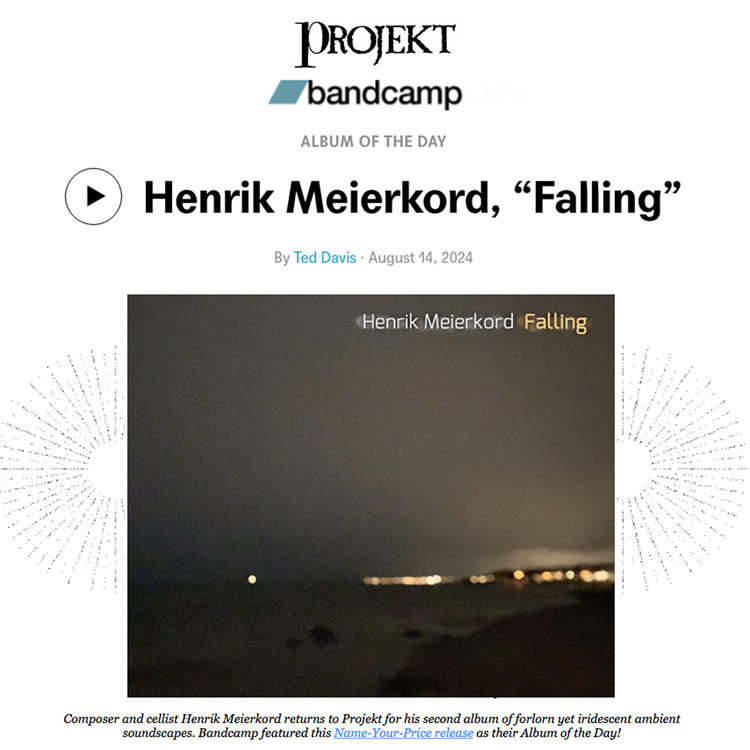
The cover of Henrik Meierkord’s new album, Falling, is adorned with an indistinct photo of a dusky coastline. While the windswept aspects of the image suit the record’s overarching stoicism, its blurriness feels out of place. The Stockholm-based musician’s latest comes across sharp and brainy, baroque stringwork framed by dynamic composition. Steeped in pensive drama, Falling plays like the aural equivalent of a provocative photo captured with a cutting-edge lens.
Meierkord debuted as a solo artist in 2018 and immediately hit a prolific stride. In the six years since, he’s put out 15 records under his own name, on top of collaborations alongside Marco Lucchi, Jarguna, and others. Though Meierkord’s work centers on the use of violin and cello, don’t get it twisted—Falling is far from your run-of-the-mill contemporary classical release. Where so many of his peers use traditional instrumentation to craft pristine scores for imaginary nature footage, Meierkord’s murky pieces call to mind thematically challenging prose.
Across Falling, unsettling waltzes comfortably mingle with billowing drones. “Sonneri de Viola et Violincell” is the eeriest track, evoking a candlelit room in the middle of a stone labyrinth. Closer “Summerbreeze” contrasts the seasonal implications of its title, more tepid and introspective than warm and gregarious. Opener “Tonalitet” creeps in with deep, serrated swells that remain at a low hum for three minutes. “Sarabandesque Streicher” emerges from an inky place, but bursts into an uplifting climax around the halfway mark. The most tingly moment arrives with “Ambient Dreams,” on which crystalline electric guitar harmonics peek out from behind a stormy foreground. United by Meierkord’s unbounded bowing, the whole album seems to be painted from broad strokes of dark gray and wine red.
Meierkord’s process often stems from a place of anxiety, serving as a balm for spells of unease. But unlike so many ambient-adjacent musicians today he’s not using soundscapes as a conduit for wellness. Instead, Meierkord probes his inner darkness, locating a wellspring of creative energy in internal tumult. “There is negative silence, when you can’t fall asleep during the night and the silence is eating you up, you can hear the postman drop the newspaper in the letterbox. The highway heard nearby makes me anxious when that happens, but a train that passes feels more comfortable,” Meierkord once mused. Falling lingers at the intersection of these two reactions, as much a hesitant affirmation as an unnerving growl. -Ted Davis